Cure Girl Lolly’s Visit to the Reeve Irvine Research Centre in California

Lolly Reeve Irvine Center 1

On Wednesday 13th July I had the privilege of going to visit the Reeve Irvine Research Centre, University of California to meet with Dr. Oswald Steward (Director of Reeve Irvine Research Centre) and Tania Jope (Director of Community Development).
As we entered the very impressive building I noticed pictures of the late Christopher Reeve and also Roman Reed who is one of the world’s leading cure advocates in the spinal cord injury world. Roman also raises huge amounts of money for the research centre.
We went to Dr. Steward’s office and we spoke about what research is going on at the moment and also asked the very important question for chronic spinal cord injuries, what’s going on for us. Lolly reeve irvine center 2
“The Corticospinal Tract Regeneration Project has been the focus of the Steward Research for years. It has involved a multi-investigator collaboration that has been following up on a paper the team published in 2010. The original paper published in Nature Neuroscience, showed it was possible to induce regeneration in corticospinal tract (CST) following spinal cord injury by deleting a gene called phosphatase and tensin homolog (PTEN). The latest papers from the Steward Lab published in 2015 showed that CST regeneration was accompanied by recovery of motor function.
In a new breakthrough, collaborator Dr. Kai Liu (he has his own lab at Hong Kong University) published a very important paper showing that it is possible to induce CST regeneration in the chronic setting either 4 months or 1 year after a spinal cord injury!
In the study Dr. Liu used the same genetic deletion strategy that was used in the original paper. Mice received spinal injuries and then 1 year later, received an injection of a viral based vector into their cortex, which produces a protein that deletes PTEN from the nerve cells that give rise to the CST. After deleting PTEN, CST axons regenerated past the injury and formed new connections. The discovery that regenerative ability can be rebooted even 1 year after an injury greatly extends the window of opportunity for regenerating connections of the spinal cord. Next steps will be to determine if the generation is accompanied by reversal of paralysis.”
The bottom line is, and a familiar story from every researcher I speak to is money. The facility is basically needing approx $250,000 for every study that would get this research into clinical trials. I asked if the US government fund any of the studies at the Reeve Irvine Centre and the answer was “no.” Dr. Steward said it’s extremely difficult getting funding from the government and they rely purely on donations and fundraisers. This is exactly what’s happening in the UK and is completely dreadful news to people who have lived with spinal cord injury for many years.
lolly reeve irvine center 3But when I asked Dr. Steward if he was optimistic that there would be a future cure for chronic spinal cord injury he replied “Yes indeed! It’s a very exciting time for research with all what’s going on at the moment.”
I also had a tour of the laboratories where the research is carried out and saw lots of very impressive equipment being used. These people doing this everyday are truly inspiring! It was great to see.
It was great opportunity for me to meet the wonderful Dr. Oswald Steward and also to tell him about the mission of the Cure Girls too! A huge thanks to you and your team Dr. Steward for your work to potentially get people independent again and out of wheelchairs!
Thanks also to Tania Jope for welcoming us and showing us around. Last but not least, thanks to Roman Reed for the introduction and keep up your amazing cure advocacy work! Kudos to you.

You can make a donation to the Reeve Irvine Research Centre here: www.reeve.uci.edu

Cure Girl Lolly

Me before You: “Can you really blame this man for his choice?”

Me before you 1Few weeks ago the film “Me before you” has been released in England; it is based on the book by the English writer Jojo Moyes which I finished reading some days ago. This is about Will Traynor, a handsome, rich, active young man, with a great career, who finds himself quadriplegic following a spinal cord injury (quadriplegia = paralysis in all four limbs).

After two years in such conditions, he decided to give himself six months time to “organize” his assisted suicide. Meanwhile his parents search for a carer, and it comes a girl next door, Louisa Clark, at the beginning unaware of the decision of his employer, but when she found out it she decided to make him live as many experiences as possible to try to dissuade him from that idea.

On the issue of euthanasia many disabled people have raised their protests:

“Why cinema depicts us negatively? Why do we have to appear weak, submissive, eager to get rid of our life if it doesn’t gives us everything we want? Life is worth living even with a disability, and it can be even happier than a life with no disabilities…” and so on.

Well, to all disabled people who got offended by this “negative” behaviour of the protagonist of the story, I’d like to say: you have made, consciously or not, the choice to live in spite of everything (that’s been my choice too so far). So live your life as you think, without worrying about what non-disabled people may think of you… because whether you’re happy or not with your disability or “different ability” (name it whatever you want, it does not change its meaning), non-disabled people will always be afraid that such a fate could happen to them, so they will admire you for your strength (someone will even envy you), but they will always think “if this shit happens to me, I could not bear it.”

Also there is no need to be scandalised by those who “accept” the dramatic decision of a family member to put an end to his/her life full of suffering.

It takes courage to choose to live in spite of everything, but choosing to die is not a light-hearted decision. It is not an act of cowardice and it should be respected.

And finally: if you are a disabled with no need to be assisted in doing the activities of daily living, you don’t have the arguments to judge properly… so please don’t play the role of moralist.

This is what Will says to Louisa about his intention to die:

me before you cover film“I don’t want you to be tied to me, to my hospital appointments, to the restrictions on my life. I don’t want you to miss out on all the things someone else could give you. And, selfishly, I don’t want you to look at me one day and feel even the tiniest bit of regret or pity and…”

“I would never think that!”

“You don’t know that, Clark! You have no idea how this would play out. You have no idea how you’re going to feel even six months from now. And I don’t want to look at you every day, to see you naked, to watch you wandering around the annexe in your crazy dresses and not… not be able to do what I want with you. Oh, Clark, if you had any idea what I want to do to you right now. And I… I can’t live with that knowledge. I can’t. It’s not who I am. I can’t be the kind of man who just… accepts”.

Just take some time to think about that… can you really blame this man for his choice?

Cure Girl Barbara

Cure Girl Lolly: “My Battle with Medication”

Cure Girl Lolly La mia battaglia con i farmaci_Fotor

After being paralysed for over 10 years, I made a big decision to come off my medication which I took for chronic pain. To be honest it was for many reasons not just one but I didn’t realise what was ahead of me. The drug I took is used to treat nerve pain after a spinal cord injury. I suffer with CHRONIC neuropathic pain which can get unbearable at times, like many other people living with a spinal cord injury. I went to see my spinal consultant, who is lovely and through her advice I was weened off over a period of 6 weeks; so gradually and under professional advice.

As the medication started to reduce, that’s when the trouble started. The insomnia kicked in straight away and the pain kicked in stronger. Then I started to get nausea which lasted all day and all night. I used to perspire so much but then be shivering at the same time, just like you see people who are drug addicts. I couldn’t believe what was happening to me. I was crying everyday, feeling so depressed and low, what with the lack of sleep it was just like torture. There were so many other withdrawal symptoms I had such as loss of appetite, itchy skin, upset stomach, lack of concentration. The list is endless! I could not believe what I was experiencing and I had to google my symptoms as I couldn’t believe it was due to coming off my medication but when I read the stories of other people’s experiences I was in total shock! Most people saying that they had to go back on the drug as they could not handle how awful they felt.

I contacted my consultant and she couldn’t believe that my withdrawal symptoms were lasting so long, but I decided to carry on and hope that the symptoms would eventually wear off. All in all these lasted for 3 months. I have to say it’s one of the hardest things I’ve ever done and I don’t know how I got through it but I did. Now 18 months later, medication free I am so glad I did it. Yes, I still have chronic pain 24/7 which never goes away but I try and use other methods to deal with it. The thing is the medication never took the pain away it only took the edge off so what was the point? The benefits for me for coming off are remarkable, I’m finally at my weight I was 12 years ago pre-injury and dropped 2 dress sizes. I feel better knowing I’ve a healthier lifestyle and my skin looks better too.

People are unaware of so many health issues that go along with spinal cord injury and we are given so much medication from the time we are hospitalised with our injury that when we leave to come home after having so much crap to deal with as it is that we don’t question WHAT exactly it is and why. Be aware of what you’re taking and why. It’s taken me so long to write about this as just remembering it is awful.

On a night out with my friend Michelle we bumped into Russell Brand in our local pub and she told him about what I’d done and he said: “I bet it was more difficult for you coming off prescription drugs than it was heroin”. That sentence made me think he’s bloody right!

Bottom line is be aware with what you’re taking!

Chronic spinal cord injury must become curable!


Cure Girl Lolly

FOOLISH NEUROSCIENTISTS WANTED!

WantedThe Cure Girls are looking for neuroscientists crazy enough to think that CHRONIC Spinal Cord Injury can become CURABLE!

“Here’s to the crazy ones. The misfits. The rebels. The troublemakers. The round pegs in the square holes. The ones who see things differently. They’re not fond of rules. And they have no respect for the status quo. You can quote them, disagree with them, glorify or vilify them. About the only thing you can’t do is ignore them. Because they change things. They push the human race forward. And while some may see them as the crazy ones, we see genius. Because the people who are crazy enough to think they can change the world, are the ones who do.”

“Stay hungry stay foolish” – Steve Jobs

If you think you have this spirit in your blood please write us at: curegirls@gmail.com

Tell us what you think is needed to find a cure for CHRONIC Spinal Cord Injury and we will find a way to support you.

We will do WHATEVER IT TAKES to make it happen!

Cure Girls

What happens when you lose the use of your arms?


When you suddenly find yourself with a disability, you live with a painful and an uncomfortable situation. And when the disability impairs your personal autonomy, the discomfort is not only of the person directly affected, but also of your loved ones. Everything is distorted and you must adapt to the new situation if you want to survive. So far the diagnosis of a spinal injury is this: the sentence to life in a wheelchair that, at best, you can push it with your own hands; at worst, with a mechanical ventilator attached behind it. When you hear the phrase “you can not walk anymore,” the sky falls. At least that’s what I often read or heard by people who have lost the use of their legs. In a condition of paraplegia (paralysis of the lower limbs) you must rebuild your life according to the new unexpected situation. You have to get removed any obstacles, but often this is not enough, you must do further work to build ramps, elevators, expand doors, modify bathrooms… and sometimes even that is not enough, you are forced to move. Also do not forget those who are forced to resort to care homes, because they have neither home nor family. Those who had already a job are lucky if they can continue with the same occupation, or at least to move to office duties. Among the lucky ones there are those who can find a job for the first time. So you try in every way to live at the best of your possibilities, through highs and lows, depriving yourselves of many things you did before and adding others that you do not want.
What happens when you also lose the use of your arms?
The only thing shared by a condition of paraplegia and quadriplegia (paralysis of all four limbs) is the reaction to the communication of the diagnosis. Everything that follows is certainly amplified to the umpteenth degree… and I’m referring only to the problems related to the injury. In addition to these problems, the quadriplegics must also suffer the total dependence on others to carry out all the activities of daily living. A situation that puts a strain on the person assisted and who offers his/her assistance, particularly if the disability is permanent. The first people to take care of are the family members, but obviously it is a situation that can not last long, and it is right and proper that way… for both the disabled person and his/her loved ones. The personal assistant (carer) is someone who takes care of quadriplegics. In most cases, it is natural that a family member takes care of a child, a mother, a father, etc. In carrying out delicate actions you need both sensitivity and some coolness; but most of all, it’s needed mutual respect. To put it bluntly, no one likes to get his/her physiological daily actions made by someone else… and who says the opposite, consciously lies. The relationship of trust and confidence that there is with a family member makes this discomfort less unbearable; and it is unlikely to happen the same with a professional assistant, even though they are professional and trained. For a person relying on help with everything it is very difficult to find someone who meets the requirements you need. Even worse, searching for a carer can take too long, making the disabled person in a state of anxiety. From here it takes a little to move to frustration, thinking about when the time comes and a stranger has to be part of your life… (and not for sentimental reasons). Disabled people with the use of arms and hands, albeit on a damn wheelchair, don’t need to think about assistance. They don’t have to think about what to do if they remain alone… their mind never crossed by the thought if it might be the best to be gone before their loved ones. While they’re getting up by themselves, going to the bathroom, doing their own things, getting ready to go out to work (maybe angry, because they wanted to stay in bed), running an errand for their mother, going out with a friend, and so on. They will think about how happy they were when they used to go the beach and walk along the shore, used to go dancing on Saturday night, had no problems of infections, their whole body was sensitive, and so on. They don’t think they are alone in the bathroom, in the shower, at the wheel of a car, and don’t need anyone to do those things for them. Maybe sometimes they think about that… and they have thanks that the worst (quadriplegia) didn’t happen to them. Conclusion: SCI is an ugly beast that may cause serious and permanent disabilities. The worst is to suffer an injury in the seven cervical vertebrae (in the neck), and the worst of the worst in the first three. The research is still in the experimental stage. “We do not know the solution yet, but the road we have taken is the right one.” More or less, this is the answer of scientists and researchers to the question “When there will be a cure?”. And while they continue on the right path making small steps, the people involved wait for… some are carefree, some less, some not at all. In the meantime, though, you can choose to fight to highlight on the URGENCY of finding soon a cure for all types and levels of injuries, bringing to public attention the true reality of what a spinal cord injury involves, so that the voices encouraging scientific research to hurry in finding a cure, are much more and make more noise than cheers of admiration to those who claim not to be disabled, but stay just seated.

Cure Girl Barbara

Milan – Channel Islands – Brasilia: The Cure Girls at the Wings for Life World Run 2016!

on stage wr2016

The Cure Girls took part at the 3rd edition of the Wings For Life World Run on May the 8th 2016 to raise money For the Wings for Life Spinal Cord Injury Research Foundation and to make sure our message is heard loud and clear: Chronic Spinal Cord Injury Must Become Curable!

wr2016 -all cure girlsThe cure girls partecipated together with the fantastic “Cure Girls Team” made of 50 friends and supporters that runned with us and for us to support research to find a cure for chronic spinal cord injury. Arcangela, Barbara, Marina, Lolly and Loredana were in Milan (Italy), Sabrina was in Brasilia (Brazil), while Rebecca pushed from the Channel Islands (UK) thanks to the App created by the organizers  to allow people to partecipate also in case they could not make it to one of the cities around the world where the World Run was taking place (see our pictures here).

Wings For Life saies that together we have run 1,255,000 kilometers and raised 6,600,000 euros that will go all for research to find a cure for paralysis!

The global champion Giorgio Calcaterra (ITA) ran record-shattering 88.4km | 54.9mi to outperform 130,732 athletes around the world.

The Cure Girls are very happy to have contributed to the success of this global event that brings hope to all the people living with paralysis and fighting to make a cure happen as soon as possible!

Thanx to all of you for running, volunteering, donating, watching and cheering.

Registration for 2017 is already open. Sign up today: http://win.gs/WorldRun2017

See you all on May 7th 2017!

Cure Girls

Follow the Cure Girls at the World Run

wflwr banner

Milan – Brasilia

Just a few hours to the Wings for Life World Run and Cure Girls are preparing to push for a cure with all the supporters who have joined the Cure Girls Team.

If you cannot be with us in Milan or in Brasilia follow us on our Facebook page, we will post photos and videos in this album

Wings For Life World Run 2016 – The Cure Girls Push for a Cure!


Schermata 2016-04-02 alle 23.19.54

Just a few weeks to the third edition of the Wings for Life World Run!

This year all the Cure Girls will partecipate (click here to see pictures of our participation in the last editions). The World Run is a big global event to raise money and awareness for research to cure paralysis and for the third time we have decided to support this event. We created the Cure Girls Team, now we have already more than 30 people in the team (many more will join us in the coming days).

Our goal is to spread loudly an important message: “Chronic Spinal Cord Injury Must Become Curable”! You can help us by registering for the World Run and then joining our team! All you need to do is to go to the Wings for Life World Run web site and register for the race. Run for those who can’t! 100% of the registration fee will go directly to spinal cord injury research. come iscriversi al cg teamThen to join the Cure Girls Team, after the registration, you can click here and follow the instructions. Add the e-mail address that you used to register and click “Join this Team”, It is also necessary to access at the link that will be sent to you by e-mail, move the “gray” button from left to right until it turns blue, then confirm that you want to be part of our team by clicking “close.” The italian Cure Girls Arcangela, Barbara, Loredana and Marina and the british Cure girl Lolly will be waiting for you in Piazza Castello in Milan on May 8th at 13:00 local time. Sabrina will be waiting for you in Brasilia at 8:00. Rebecca will race in the Channel Island (UK) using the new app that will allow you to participate even if you will be in a city different from those chosen by the organization.

Stay with us! Run / push with us to Cure paralysis!

See you on May 8!

Cure Girls

Happy Easter, Buona Pasqua, Feliz Páscoa!

Happy Easter

Happy Easter, Buona Pasqua, Feliz Páscoa!

Cure Girls

Update from Poland: “Recruiting of new patients begins.”

_78415257_darek-tabakow-raisman

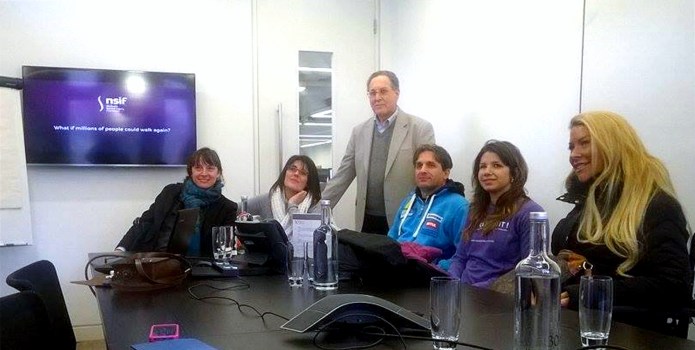
One year ago the Cure Girls were in London at the headquarters of Nsif to learn more about the line of research of prof. Raisman and dr. Tabakow, both supported by Nsif. The goal of this research is regeneration of the nerve fibers in the spinal cord and it is applicable to chronic SCI as shown for the first time by the functional recovery achieved by Darek Fridyka that has been scientifically documented. After our meeting in January 2015 the cure girls have concluded to donate more than 70000€ to NSIF.

The medical team is now launching a worldwide search for two more patients. Read more

Cure Girls