
Cure Girl Lolly
On Wednesday 13th January I was absolutely delighted to be invited along to BBC Radio London to have an interview with the brilliant Eddie Nestor on his Drivetime Show.
Eddie talks about serious topics/issues and peoples views in London and I was nervous but excited to speak about my story, latest fundraiser and the Cure Girls mission “live” on the radio!
Dr Mark Bacon, Executive Clinical Director of Spinal Research also accompanied me and spoke about the fact that the charity isn’t government funded, the statistics of people living with a spinal cord injury in the UK and also the complex issue of a cure.
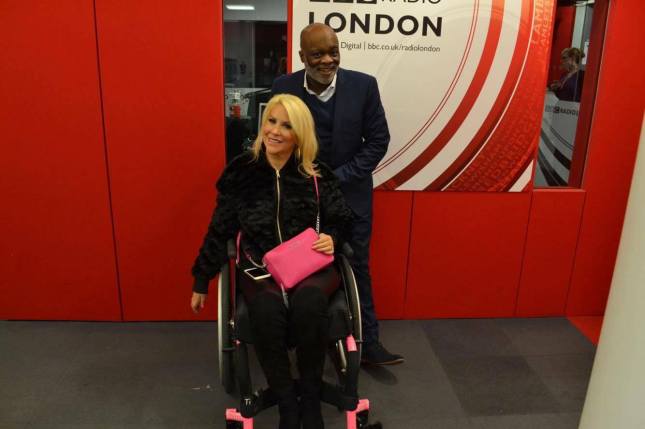
I mentioned my latest challenge which is a 285 mile virtual London to Paris cycle on my FES bike to raise as much money as I can for Spinal Research. This was a great opportunity and I’ve had lots of messages of support from lovely people and some donations which have been amazing.
You can still listen to the interview here: http://www.bbc.co.uk/programmes/p03cnh9n#play and using the slider go to 2 hours and 6 minutes.
Cure Girl Lolly.
You can still sponsor me, I’m on Day 5 of my challenge and I’ve cycled 115 miles so far. Please go to www.justgiving.com/Lorraine-Mack5 all donations could potentially get people out of wheelchairs!
Thanks so much!


 La lesione da taglio è quella che meglio si presta per questo scopo. Quindi questo studio non ha lo scopo di dimostrate che la rigenerazione è possibile nella lesione spinale contusiva, ma quello di dimostrare che la rigenerazione è possibile dopo una lesione spinale cronica in genere. Ciò rappresenta il primo passo indispensabile per arrivare ad una terapia efficace anche per le lesioni contusive che sono la maggior parte delle lesioni spinali.
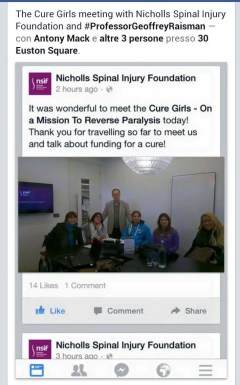 Regulars to the blog will remember that it was Prof Raisman and Dr Pawel Tabakow who published ground
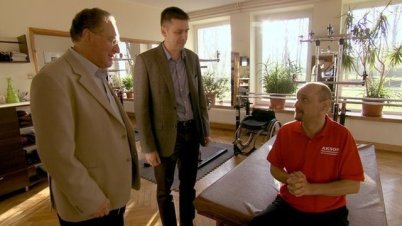
  The team of researchers wanted to show beyond a doubt that the recovery seen in the well documented patient, Darek Fidyka, was from regeneration and not from plasticity. The transection model was ideal for this. It’s important to grasp that this research was not aimed at proving regeneration in contusion type injuries; it aimed to prove that regeneration is possible. Therefore the researchers chose the most appropriate injury model to prove this. Once the replication study has been accomplished, the surgery technique will need to be adjusted to contusion type injuries. Moving forward there are multiple challenges, not least raising sufficient funds to commence replication tests and to continue the search for more effective cells.
 CURE GIRLS